Weighing Cost Per Litre Cleaning Chemicals in West Bridgford: The Real Figures
Weighing Cost Per Litre Cleaning Chemicals in West Bridgford: The Real Figures
Blog Article
Cost Per Litre Cleaning Chemicals: The Real Maths
Most commercial cleaning budgets leak money. Buyers review products on invoice pack price rather than in-use dilution. A five-litre concentrate drum at twenty pounds seems cheap. A ready-to-use trigger spray at two pounds sounds cheaper still. Both assumptions scrubber dryer chemicals fail under plain arithmetic. Identifying the genuine cost per litre cleaning chemicals involves gauging the yield of working solution, not comparing container sizes.
Ready-to-use formulas compel organisations to move municipal tap water inside single-use plastic bottles across UK road networks. Meanwhile, unsupervised manual pouring sends valuable concentrate straight down the sink. Are you confident your facilities team pays for active chemical agents rather than bottled water?
Key Takeaways
- Appraising cleaning chemicals by pack price rather than ready-to-use working solution conceals real operational spend and clouds extended procurement budgets across all facilities.
- Water represents approximately 740ml of typical ready-to-use trigger bottles, meaning organisations pay higher delivery and packaging rates for pre-bottled tap water.
- Over-concentration by manual free-pouring remains the single largest unnoticed driver of chemical waste, chemical residue build-up, and avoidable contract expenditure on commercial sites.
- Pre-dosed soluble sachet systems remove measuring errors entirely, locking dilution ratios to secure consistent compliance standards alongside predictable contract expenditure per task.
- Calculating chemical yield per application overhauls floorcare budgeting, cutting mopping expenditure to pennies per bucket and machine scrub tank fills substantially.
In-Use Chemical Costs Across Common Formats
Clear comparisons between chemical formats demand converting prices to the final ready-to-use state. Standard ready-to-use bottles look cheap on a single invoice line. They carry massive mark-ups per working litre. Concentrated formats and pre-dosed powders shift that balance sharply. They remove the logistical burden of moving water across supply chains.
The table below sets out costs per ready-to-use litre across common commercial cleaning categories. In practice, list price alone misguides buyers badly. It conceals distribution penalties. It also increases recurring operational expenses across multi-site UK facilities. Yield is the only figure that allows a fair comparison between formats.
| Product Application | Pack Format and Price | Working Solution Yield | Cost Per Ready-To-Use Litre |
|---|---|---|---|
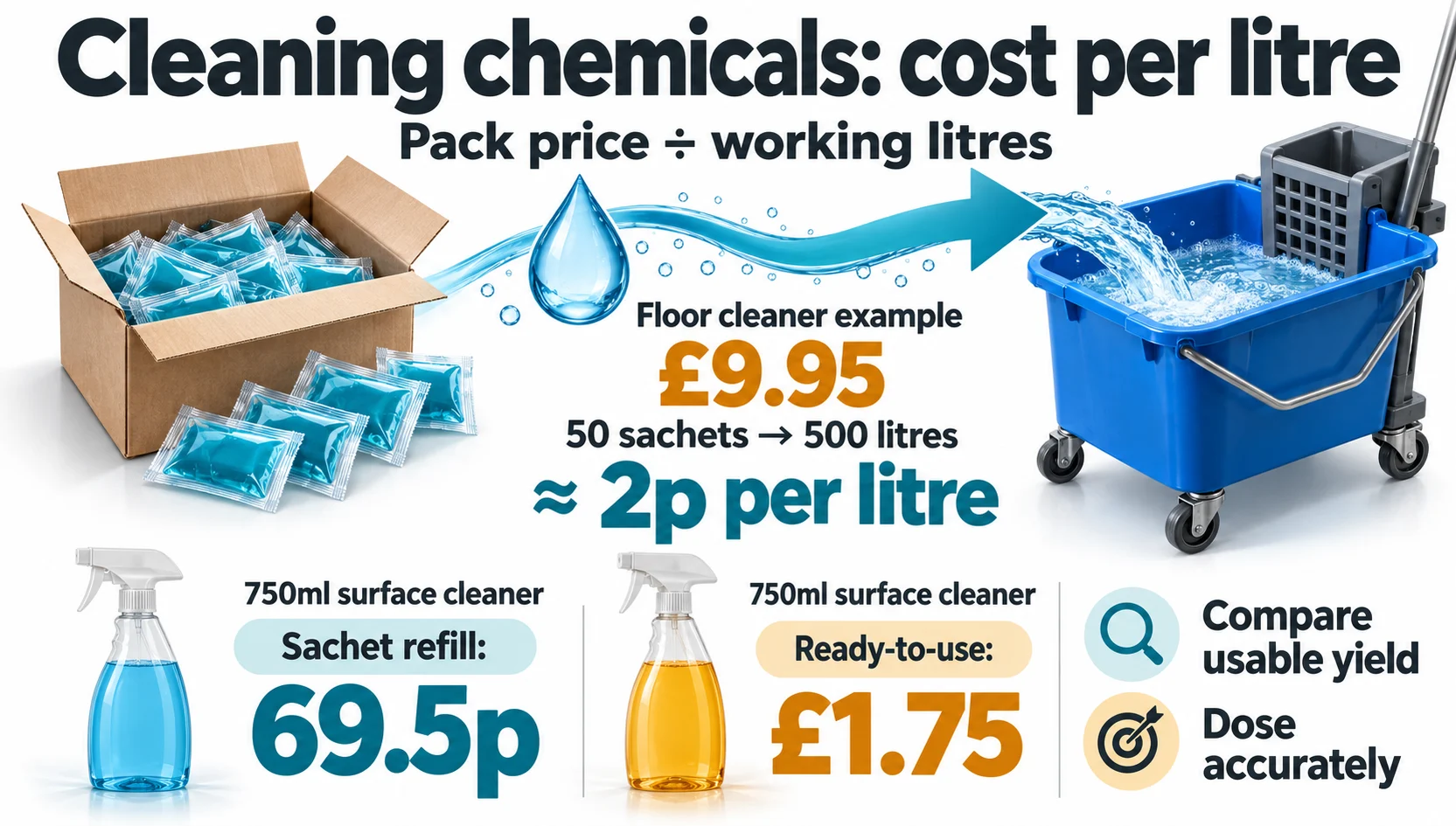
| Hard Surface Floor Cleaner | 50 Sachets (£9.95) | 500 Litres (10L per dose) | £0.020 |
| Washroom Floor Disinfectant | 50 Sachets (£9.50) | 500 Litres (10L per dose) | £0.019 |
| All Purpose Surface Cleaner | 10 Sachets (£6.95) | 7.5 Litres (750ml per dose) | £0.927 |
| Scrubber Dryer Solution | 30 Sachets (£11.95) | 900 Litres (30L per dose) | £0.013 |
| Typical Ready-To-Use Trigger | Single 750ml (£1.75) | 0.75 Litres (no dilution) | £2.333 |
The In-Use Calculation Method
The Working Solution Formula
Working out the true price of cleaning chemistry necessitates a clear three-stage calculation. You divide the total pack purchase price by the number of doses included. Then you divide that unit dose price by the litres of usable solution produced. This formula reveals real expenditure instantly.
From experience across the sector, procurement teams asking how to work out cleaning chemical cost per litre forget to account for yield. A fifty-pound drum that yields five hundred litres of working solution costs ten pence per litre. A ten-pound container making only twenty litres costs fifty pence per litre. Weighing invoice prices alone flips the genuine monetary picture.
Pack Price Versus Delivered Volume
A chemical drum sitting in a janitorial cupboard indicates prospective working liquid, not immediate ready-to-use volume. Regarding products through this lens forces managers to track dilution ratios accurately. High-dilution concentrates provide substantially greater working volumes than bulky, low-dilution alternatives bought at seemingly sharp rates.
When purchasing managers judge chemical options on list price alone, they disadvantage ultra-concentrated formats. Factoring container yields into purchasing schedules shifts that picture. Bigger initial pack prices regularly yield the smallest commercial cleaning chemical cost across an entire contract period.
The Hidden Expense of Shipping Water
Ready-To-Use Packaging and Freight Overhead
Ready-to-use cleaning solutions consist almost entirely of standard municipal tap water bottled in plastic. A regular 750ml trigger spray bottle includes roughly 740ml of water and only 10ml of active cleaning ingredients. Moving pre-mixed water across regional distribution networks incurs unnecessary carriage, fuel surcharges, and storage overheads.
Every case of ready-to-use spray bottles represents weighty, dead weight on a delivery vehicle. Hauling water burns fuel, creates logistics expenses, and requires sizeable warehouse staging areas. Facilities paying for pallet deliveries of pre-diluted liquids subsidise the transit of water that flows cheaply from local taps.
Disposal Costs and Packaging Volumes
Ready-to-use bottles create ongoing single-use plastic waste that facilities must store, handle, and pay to remove. Once emptied, the plastic bottle, dipping straw, and trigger head pass into waste streams. Treating these large items raises commercial refuse disposal charges across operations.
In contrast, concentrated systems lessen rigid packaging. Reusable trigger bottles paired with concentrates end repeated container purchases entirely. Cutting plastic waste volume directly lessens in-house handling time, bin store congestion, and full commercial waste management fees.
Did You Know?
Regulation 6 of the Control of Substances Hazardous to Health Regulations 2002 requires a suitable and sufficient risk assessment before any work with a hazardous substance begins. Under the Sentencing Council guideline in force since 1 February 2016, health and safety fines in the Crown Court are unlimited.
Operational Impact of Over-Dosing
The Glug Factor in Daily Tasks
Manual free-pouring without measuring cups remains the primary cause of padded chemical consumption across commercial sites. Cleaning operatives frequently assume that introducing extra chemical hastens grease breakdown or floor cleaning speed. This glug factor quickly burns through concentrated drums, doubling or tripling projected material costs.
Unchecked pouring also leaves chemical film on polished floors. That film generates slip hazards and requires additional rinsing. In active logistics hubs and engineering sites, adhesive residues attract fine dust. Surfaces then re-soil rapidly after cleaning.
Predictable Dilution Through Pre-Dosed Sachets
Water-soluble sachets completely stop operator dosing errors by enclosing accurate chemical quantities for specific container sizes. Staff drop one pod into a bucket or trigger bottle filled with pure water. The system eliminates manual measuring jugs, pumps, and guesswork from daily routines entirely.
Because operative dosing stays uniform across every shift, supervisors project consumable expenditure with true precision. Chemical budgets no longer shift with specific pouring habits. Long-term spend then aligns with the original commercial tender.
Real-World Floorcare Cost Analysis
Cost Breakdown for Mop Buckets
Floor maintenance across high-traffic facilities takes large volumes of chemical solution every week. Using a hard surface floor cleaner sachet costing twenty pence creates ten litres of solution. This sets the finished solution at exactly two pence per litre inside a standard mop bucket.
At two pence per litre, cleaning an entire commercial entrance costs twenty pence per bucket change. Compare that with unchecked liquid detergent. An operative might pour sixty to eighty pence of concentrate into the same bucket. The hygienic result is no better.
Scrubber Dryer Chemical Requirements
Scrubber dryers treat extensive floor plates rapidly but require tightly controlled foam levels and chemical proportions. Running a forty-litre scrubber dryer tank using heavy-duty sachet solution costs approximately fifty-three pence per fill. This economy shields margins on major commercial cleaning contracts.
Take an operative running a forty-litre scrubber dryer twice per shift. Across an industrial estate or manufacturing premises, daily chemical spend equals roughly one pound. That predictability holds large-scale mechanical floor maintenance within set tender budgets.
Trigger Sprays and Surface Cleaning Budgets
Daily Task Economics
Surface cleaning triggers constitute the top volume consumable line for daily ordinary office and school cleans. A ten-pack of all-purpose surface cleaner sachets costs £6.95, yielding ten 750ml trigger sprays. Each ready-to-use bottle therefore costs approximately seventy pence to make on site.
Buying three refill packs cuts that cost further, to sixty-seven pence per bottle. A tough spray bottle comes free of charge. Equivalent ready-to-use retail sprays cost around £1.75 per unit. The gap represents a sixty percent price reduction.
Annual Multi-Site Savings
Modest price variations per trigger bottle compound rapidly across multi-site commercial estates. A business operating ten commercial sites typically needs fifty trigger sprays weekly, or 2,600 bottles annually. Usual ready-to-use bottles at £1.75 each accumulate an annual chemical spend of £4,550.
Supplying the same estate with pre-dosed sachets at seventy pence per bottle costs £1,820 over fifty-two weeks. Switching to sachet concentrates cuts £2,730 annually on that individual product line. The released capital funds equipment maintenance or team training.
Storage Space and Manual Handling Realities
Janitorial Cupboard Capacity and Stock Density
Typical chemical containers use large floor space in controlled janitorial stores. Storing twenty-litre drums and boxes of pre-diluted sprays cuts room for machinery, backup pads, and fresh microfibre cloths. Concentrated water-soluble pods take ninety-six percent less storage space compared to conventional cleaning supplies.
A single trim carton carrying fifty sachets displaces five hundred litres of bulky liquids. Cleaning teams often work from tight urban spaces or shared commercial facilities. Those teams can store three months of running stock inside an ordinary drawer. Corridors stay clear.
Manual Handling and Health Compliance
Moving weighty drums of fluid generates lasting manual handling risks for cleaning staff. Decanting weighty containers into reduced dispensers triggers chemical splashing, skin irritation, and COSHH compliance incidents. Trim sachets trim product transit weight by ninety-nine percent, simplifying internal logistics across every site.
Removing heavy lifting safeguards staff from musculoskeletal strain when stocking janitorial stations across multiple floors. Sealed soluble films stop chemical contact with skin during preparation. In practice, this keeps handling clean and upholds workplace health standards.
Contract Tendering and Margin Protection
Accurate Consumable Forecasting
Bidding competitively on facility maintenance contracts necessitates careful forecasting of operational consumable costs. Estimating chemical expenditure using uncertain free-pour concentrates compels estimators to include cautious contingencies. Factoring in fixed sachet rates enables bidding teams to cost consumable lines with razor-thin precision.
Fixed dosing confirms operational site spend matches tender models exactly. Contract managers monitor chemical stock consumption against square metre cleaning frequencies. That visibility exposes unauthorised usage or inventory loss before margins deteriorate.
Sustainability Evidence for Tender Panels
Contemporary cleaning tenders place major commercial weighting on environmental performance, carbon reduction, and packaging waste diversion. Transitioning an estate to ultra-concentrated dry sachets lowers freight transport emissions sharply. Facilities managers and procurement panels actively credit providers who remove single-use plastic waste from their premises.
Concentrated pods divert thousands of plastic bottles from landfill each year. Audited packaging and transport emission figures carry real weight with evaluators. Presenting them assists contractors score strongly on sustainability sections during contested procurement.
Final Thoughts
Applying the genuine cost per litre cleaning chemicals lets commercial operators manage budgets systematically. Relying on list prices or buying pre-diluted liquids compels facilities to overpay for water haulage and packaging. Moving to concentrated, pre-dosed formats trims underlying expenditure, prevents over-dosing, and simplifies on-site storage.
Plain dilution calculations let procurement leads structure supply chains around confirmable chemistry yield. Standardising on pre-dosed systems holds hygiene standards steady across every clean. Material and budget waste both drop as a result.
Frequently Asked Questions
Q: What is the simplest way to calculate cleaning chemical cost per litre?
A: Divide the total purchase price of the pack by the number of doses it contains. That gives you the price per dose. Then divide that single dose cost by the litres of water mixed with it. For example, a 50-pack costing £9.95 amounts to roughly twenty pence per sachet. If one sachet mixes into ten litres of pure water, the real cost per ready-to-use litre is exactly two pence.
Q: Why is buying ready-to-use cleaning chemicals considered a false economy?
A: Ready-to-use products contain roughly 740ml of water per 750ml bottle. Only a tiny volume is active concentrate. Businesses sourcing these bottles pay mainly for bottling, single-use plastic hardware, freight, and the warehouse storage of water. Diluting concentrates or pre-dosed sachets on site with mains water removes those overheads. In practice, the switch reduces working chemical costs by up to sixty percent.
Q: How does manual over-dosing affect contract cleaning costs?
A: Operatives who pour chemicals by eye routinely apply surplus concentrate. They suppose stronger mixtures clean better, which is wrong. This practice often doubles chemical consumption on site, running through monthly budgets in two weeks. Over-concentrated solutions also leave viscous residues on floors. Those residues attract dry dirt and create slip hazards. Correcting them requires extra labour and additional rinse passes.
Q: How do water-soluble sachets reduce warehouse storage requirements?
A: Water-soluble sachets contain active dry powder or ultra-concentrated compounds with no added water filler. They require ninety-six percent less physical storage space than ready-to-use bottles or large plastic drums. A single neat box of fifty floor cleaning sachets produces five hundred litres of working solution. Cleaning teams can therefore store months of stock inside an unremarkable filing drawer. Janitorial cupboards and warehouse racking stay clear.
Q: Are pre-dosed sachets suitable for mechanical floor scrubber dryers?
A: Yes. Pre-dosed sachets operate well across commercial scrubber dryers and automatic floor scrubbers. Tailored low-foaming formulations protect vacuum suction motors from moisture damage whilst providing effective soil extraction on heavy industrial surfaces. Operatives drop the required quantity of pods directly into the clean water tank and fill to the level line. Dosing a typical forty-litre tank costs approximately fifty-three pence per fill.
Commercial Janitorial Supplies in Yorkshire and Beyond
- Halifax Janitorial Supplies
- Barnsley Janitorial Supplies
- Bradford Janitorial Supplies
- Castleford Janitorial Supplies
- Dewsbury Janitorial Supplies
- Doncaster Janitorial Supplies
- Harrogate Janitorial Supplies
- Huddersfield Janitorial Supplies
- Hull Janitorial Supplies
- Leeds Janitorial Supplies
- Lincoln Janitorial Supplies
- Manchester Janitorial Supplies
- Rotherham Janitorial Supplies
- Scunthorpe Janitorial Supplies
- Selby Janitorial Supplies
- Sheffield Janitorial Supplies
- Wakefield Janitorial Supplies
- York Janitorial Supplies
- Grimsby Janitorial Supplies
- Chesterfield Janitorial Supplies
- Goole Janitorial Supplies
- Pontefract Janitorial Supplies
- Normanton Janitorial Supplies
- Morley Janitorial Supplies
- Ossett Janitorial Supplies
- Batley Janitorial Supplies
- Pudsey Janitorial Supplies
- Beverley Janitorial Supplies
- Chapeltown Janitorial Supplies
- Gainsborough Janitorial Supplies
- Shipley Janitorial Supplies
- Brighouse Janitorial Supplies
- Bingley Janitorial Supplies
- Retford Janitorial Supplies
- Worksop Janitorial Supplies
- Keighley Janitorial Supplies
- Dronfield Janitorial Supplies
- Bridlington Janitorial Supplies
- Scarborough Janitorial Supplies
- Mansfield Janitorial Supplies
- Cleethorpes Janitorial Supplies
- Stalybridge Janitorial Supplies
- Oldham Janitorial Supplies
- Rochdale Janitorial Supplies
- Sutton-in-Ashfield Janitorial Supplies
- Ashton-under-Lyne Janitorial Supplies
- Chadderton Janitorial Supplies
- Dukinfield Janitorial Supplies
- Nelson Janitorial Supplies
- Hyde Janitorial Supplies
- Kirkby-in-Ashfield Janitorial Supplies
- Burnley Janitorial Supplies
- Denton Janitorial Supplies
- Heywood Janitorial Supplies
- Middleton Janitorial Supplies
- Droylsden Janitorial Supplies
- Newark-on-Trent Janitorial Supplies
- Rawtenstall Janitorial Supplies
- Buxton Janitorial Supplies
- Reddish Janitorial Supplies
- Hazel Grove Janitorial Supplies
- Stockport Janitorial Supplies
- Hucknall Janitorial Supplies
- Bury Janitorial Supplies
- Ripley Janitorial Supplies
- Whitefield Janitorial Supplies
- Prestwich Janitorial Supplies
- Accrington Janitorial Supplies
- Eston Janitorial Supplies
- Arnold Janitorial Supplies
- Radcliffe Janitorial Supplies
- Salford Janitorial Supplies
- Heanor Janitorial Supplies
- Darlington Janitorial Supplies
- Middlesbrough Janitorial Supplies
- Eccles Janitorial Supplies
- Stretford Janitorial Supplies
- Carlton Janitorial Supplies
- Wythenshawe Janitorial Supplies
- Macclesfield Janitorial Supplies
- Farnworth Janitorial Supplies
- Ilkeston Janitorial Supplies
- Sale Janitorial Supplies
- Nottingham Janitorial Supplies
- Bolton Janitorial Supplies
- Redcar Janitorial Supplies
- Darwen Janitorial Supplies
- Wilmslow Janitorial Supplies
- Blackburn Janitorial Supplies
- Little Hulton Janitorial Supplies
- Urmston Janitorial Supplies
- Altrincham Janitorial Supplies
- Beeston Janitorial Supplies
- West Bridgford Janitorial Supplies